Windows, Mirrors, and Sliding Doors to the Universe

The phrase a “window to the universe” has become ubiquitous every time a new observatory or astronomical instrument is built. While there is a certain aesthetic to the phrase, when applied so often it becomes easy to not think about the message and what it is trying to convey. It makes sense to use a window as a metaphor, after all, we are familiar with how we can see outside a building through its windows. However, the “window” implies a one-way investigation; our interaction with phenomena is restricted to making a limited set of observations, from the inside looking out. If only the window were a sliding door to allow us to step through and engage directly with the phenomena!

It is perhaps somewhat ironic our instruments of choice for investigating the universe usually do so with mirrors. Metaphorically, astronomical research reflects back on our own situation here on Earth and may impact our understanding of processes essential for our existence. However, a great deal of astronomical research has little identifiable benefit beyond the expansion of a basic understanding about how the universe operates. We seldom see it acting like a mirror, reflecting back on our understanding of self or tribe. Much research in astrobiology does act as a mirror as we continue to expand our definition of both life and the conditions necessary to sustain its presence. In general, self reflection as a species is not one of our strong suits—we find it difficult to apply the knowledge gained to our own situation, brushing it off as something that happens “out there” and not here. And many times, particularly in scenarios presented in science fiction, in the presence of much evidence to the contrary, we see ourselves as thriving outside our terrestrial environment.

The arts world might shed some light on how to think about our interaction with the external universe.  In 1978, John Szarkowski, the head of the photography department at the Museum of Modern Art in New York, published an essay in conjunction with a new exhibit at the museum. The exhibit, Mirrors and Windows: American Photography Since 1960, along with his essay, suggested photographs fall into one of two categories: windows or mirrors. (Though he does suggest a continuum with the main descriptors as end points.) Not only do photographs represent either a window or a mirror, they can describe the artist’s work as a whole. Basically, the difference is between those who take photographs of things outside themselves in order to show what they look like, or their images document a process of self expression reflecting on the photographer’s self-discovery or introspection, and perhaps for observers of their images as well.

Educators face a somewhat similar task as they construct learning opportunities using a variety of resources for students to explore the external world. All too often however, these experiences are exclusively windows, bearing little relevance to the learner’s own life, and they frequently question why they are studying a particular topic, and its application to their own situation.

Emily Style in her 1988 essay Curriculum As Window and Mirror noted there is a “need for curriculum to function both as window and as mirror, in order to reflect and reveal most accurately both a multicultural world and the student herself or himself.” Style posited the need for a balanced education for everyone, to include learning about both the known and the unknown in the greater world, and knowledge of others as well as the self. To illustrate, she draws on two examples demonstrating how girls are unable to see themselves.  In one, the essayist made statements such as “why are there no great women artists?”; the second describes a story in a magazine that led with the quote “baseball is fathers and sons playing catch,” then goes on to feature only photos of fathers and sons, with a final image of a Mother and Son, with the mother having played in a women’s baseball league. Both of these examples serve to exclude girls from the scenarios, not allowing them to see themselves as participants in either art or baseball.

Both Style, and writers such as Rudine Sims Bishop considered how much of children’s literature and educational materials tended to portray a singular vision of white males as the dominant characters.  Anecdotally, it is easy to remember when the only vision one would have of a scientist was of an older white male with a variety of eccentricities seldom found in ordinary society. Thus, reinforcing the notion science was the exclusive domain of white males.

While science, and science education have made great strides in making both the phenomena, and participation in its exploration more accessible to those traditionally underrepresented in the ranks of practitioners, much work remains. Bishop suggested windows have the potential to act as sliding doors, allowing a reader to step through in their imagination to become a part of the story. Before a learner can step through however, they will need to see reflections of themselves as participants in something having relevance to their own story, and of the culture in which they are embedded. Our challenge is to break free of our own past and create a culture of science education where every learner can see themselves reflected in the ongoing story of exploration and discovery out in the broader universe.
BRK-201508132147

This post originally appeared as the Education Matters column in the Winter 2019 edition of Mercury magazine, a publication of the Astronomical Society of the Pacific.

Posted in Education Matters, Science Education, Uncategorized | 1 Comment

Feats Above

That’s one small step for [a] man, one giant leap for mankind.  – Neil Armstrong

This is the moon landing of free soloing.  – Tommy Caldwell

Driving around a corner, you go through a tunnel.  Coming out, it is all you can do to stay focused on the road.  In front of you is one of the most awe inspiring views on the planet: Yosemite Valley.

BRK-201612241337

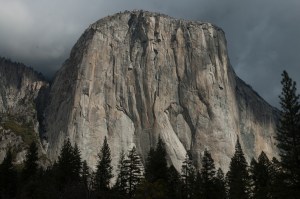
Dominating the left side of the valley is El Capitan.  Its vast bulk with sheer cliffs stretch a half-mile above the valley floor.  Standing and looking up, the top is just as remote as the moon.  And yet, at any time, there are dozens of climbers on half a hundred different routes.

BRK-201502271106

The film Free Solo follows Alex Honnold as he prepares to make the first ascent of El Capitan without any sort of aid, either tools or human, other than his shoes and a bag of chalk.  Spoiler alert, he successfully makes the climb, which does little to lessen the tension one feels while watching him work his way up the cliff.  The slightest error would have meant certain death.  While I am not a climber, I have watched them from the safety of the valley floor, and am in awe of the immensity of the sheer wall rising so far above.  Images barely convey the physical magnitude of El Capitan, or the challenge it presents.

BRK-201503010947

After seeing Free Solo, I compared it to another recent film that portrayed another first.  First Man followed Neil Armstrong through the years leading up to the Apollo 11 landing on the Moon, when he, along with Buzz Aldrin stepped out of their vehicle to explore the lunar surface.  In some ways I find Alex Honnold’s feat more amazing than that of the crew of Apollo 11.  The lunar landing required the efforts of a great many people, and any of the astronauts could have been the first person to step on to the Moon.  Neil Armstrong certainly had a set of skills and a temperament well suited to allow him to take the lead for the mission, but it wasn’t really an individual accomplishment.  Climbing El Capitan solo without ropes, or any hardware truly was an individual accomplishment, and succeeded due to Alex Honnold’s preparation and his mental and physical attributes.  So, I am conflicted in deciding which was the greater feat.


9457418581_bb2100a236_k

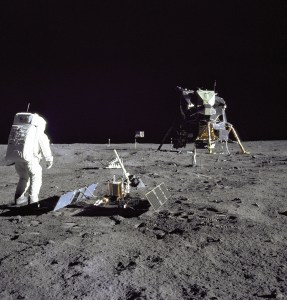
Buzz Aldrin on the lunar surface during the Apollo 11 mission. Image: NASA

Both the Moon and El Capitan require you to raise your eyes above the horizon, to turn your gaze upwards.  To most people, both are equally remote and unattainable, and we watch with amazement as more adventuresome humans dangle from ropes with little to connect them to the rock wall, or blast off from Earth at the top of a rocket on their way into space.  Both are inherently dangerous feats, and both defy gravity in their own unique ways.


Posted in Space Exploration, Stories, Uncategorized, Yosemite | Leave a comment

Lunar Inspiration

From December 2018 through July 2019, the world is celebrating the 50th anniversary of the first missions where humans orbited, then landed, on the Moon.  A total of nine Apollo missions went to the Moon and returned safely to Earth.  Two of those remained in orbit, six landed, and one other negotiated a return trajectory with a badly damaged spacecraft.

We humans love stories.  The best are the ones where we identify with the characters or events, or detail heroic deeds.  As a culture, we recognize past events and the characters who played important roles in them. From an educational perspective, these events and stories serve to inspire young learners to aspire to something beyond the ordinary.  This year and next, enthusiasts and educators will honor two such events in the history of space exploration: the fiftieth anniversaries of the first time humans traveled to the Moon, and then set foot on its surface.

The recently released film First Man chronicles the history of lunar exploration, seen through the eyes of Neil Armstrong, the first human to personally experience what Buzz Aldrin called a “magnificent desolation.”  In some ways the film also reminds us humans have not returned to the Moon since 1972. While the later landings, and much of the Space Shuttle and International Space Station programs have maintained a human presence in space, in some ways they have become ordinary, falling short of the inspiration we found in the flights of Apollos 8 and 11.  Much of our progress in science education has taken place with inspiration from, and in response to the heroic deeds undertaken in pushing the boundaries of human knowledge and capabilities.

A few years ago, the theme for the annual International Observe the Moon Night was “What does the Moon mean to me?”  Expressing meaning can take a lot of forms, most of them in the form of stories. Humans have long told stories about the Moon and what it means to them, and their culture.  As we learn more about the Moon, it turns out the story incorporates much more than the personal or anthropomorphic aspects we impose on this object in the sky. The story is one of exploration and science, as the Moon has its own story to tell about its creation and relationship to the solar system and beyond.  From this perspective, exploration is really just learning the story a place has to tell. And at this point in history we are starting to learn the language the story is in, and discovering how to ask the right questions.

It is unknown who first looked up and pondered the Moon.  There are no records. As their art attests, the Moon was important to ancient peoples.  Cave drawings over 20,000 years old are the first definitive representations of the Moon and its cycle of phases.  Bone carvings from 10,000 years earlier have groupings of 29 distinct notches, possibly marking the days of the lunar cycle.   People needed to mark time, a means to predict the movements of the herds they hunted, and the ripening of the wild plants they gathered.  As people started to live a more agrarian lifestyle it became necessary to track when to plant crops and harvest, or when to move livestock before the onset of winter storms.  The lunar cycle formed the basis for early calendars, an artifact we continue to use every “moonth.”

The importance of the Moon to early civilizations led to its inclusion in their religions, with deities and celebrations tied to the Moon and its cycle.  People told stories about the Moon, attributing its presence and phases to the actions of gods and heroes. They saw images in the pattern of craters and maria on the Moon’s surface, and imagined they were there to help in the telling of their stories.  The Moon became important in the myths and legends and deeds of adventurers and monsters on Earth, as the Moon, particularly when full, brought on transformations both physical and psychological. In our modern age we still tell such stories, and though generally recognized as fantasy, the Moon has a prominent role in many movies, with humans transforming into werewolves at the sight of the full Moon, and the light of the Moon having magical qualities.  People continue to have a sense of the magical when finding themselves on a dark night lit only by the Moon. Romantic scenes in real life as well as in film commonly involve a moonlit night. The Moon is also associated with human psychological behavior, as we commonly refer to irrational acts as “lunacy.”

The story of the Moon emerging from modern science and the explorers, human and robotic, which have landed and/or orbited the Moon is every bit as exciting and fantastic as those our ancestor told sitting around their fires.  In late December 1968, Apollo 8, with a crew of three, orbited the Moon ten times and returned safely to Earth.  This success was followed with the landing of Apollo 11 on July 20, 1969.  Both of these events have entered into modern lore, with people remembering where they were when they watched the view of Earth from the Moon during TV broadcasts from Apollo 8, and the grainy images of Neil Armstrong’s first steps on to Moon.  Today there are fewer people who were alive to see those events, than were born after.  The days of human exploration of the Moon are now, for most of us, no longer a part of our personal stories.

figure 1 Lunar Orbiter assembledimage.w

LOIMAGEreduced

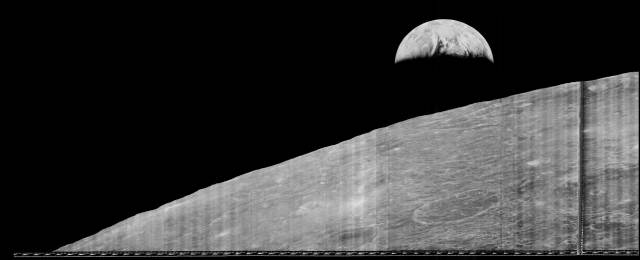
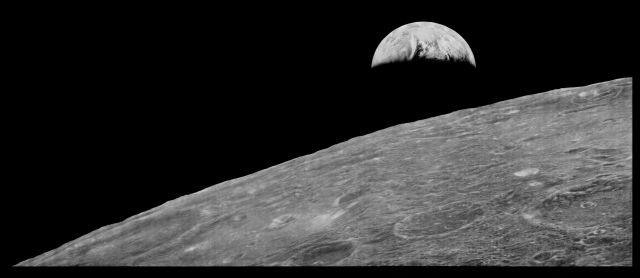
Images: Top: image from Lunar Orbiter 1 taken on August 23, 1966 as originally processed. Bottom: reprocessed image as a part of the Lunar Orbiter Image Recovery Project. Credit: NASA

When I was young, my father brought home from work a poster of a photograph with the caption “Historic First Photo of Earth from Deep Space.”  This image taken by the Lunar Orbiter 1 reversed the perspective we normally enjoy, showing a crescent Earth suspended above a lunar landscape.  While significant, this initial look at the Earth from space did not enter the collective human consciousness with the same depth as a similar image the astronauts aboard Apollo 8 took a little over two years later.

figure 2 297755main_GPN-2001-000009_full large

Image: the Earth from Apollo 8 in lunar orbit.  Credit: NASA/Bill Anders

The Moon has meant many things to, and inspired many people throughout history.  The Moon’s meaning to societies has evolved as technology and our ability to explore have become more sophisticated.  However the meaning of the Moon to us as individuals has remained fairly constant. For most of us the Moon is a place of wonder, an anchor and participant in the stories we tell and in our dreams.  The Moon is our first introduction to the wonders beyond Earth, and has the potential to serve as the first step towards the universe.

At some point in the hopefully not too distant future, humans will again walk and work on the surface of the Moon.  Turning their gaze upwards, they will see the shining Earth in the black lunar sky, and ponder. As it turns out, the question that really matters is what does the Earth mean to me?


This is an updated version of a post originally appearing in this blog in September 2014.  A version also appears as the Education Matters column in the fall 2018 edition of Mercury magazine, a publication of the Astronomical Society of the Pacific.

Posted in Education Matters, Space Exploration, Stories | Leave a comment

The Eternal Recurrence of the Mars Hoax

It is a testament to how people tend to hear what they want to hear.  The first time was in August 2003 as people were preparing to observe the closest Mars opposition in approximately 60,000 years.  A fairly innocuous statement that viewed through a telescope, Mars would look as large as the full moon with the unaided eye, turned into a widespread anticipation of how looking up, people would see Mars glowing red as large as the full Moon in the sky.  And, with the idea there was this one and only opportunity to view this wondrous event.  This so-called “Mars Hoax” makes a regular August reappearance for every Mars opposition, even if the opposition is taking place at a different time of year.

Nikon Coolpix image through a telescope during the 2003 Mars opposition.

Oppositions of Mars take place approximately every two years, due to it having an orbital period around the Sun of about two Earth years.  During most opposition years, Mars presents a brighter, and larger aspect for viewers. Less often, opposition coincides with Martian perihelion, bringing it much closer, owing to the greater eccentricity of its elliptical orbit about the Sun.  During these oppositions, such as in 2003, Mars truly does provide for a magnificent sight in the sky.

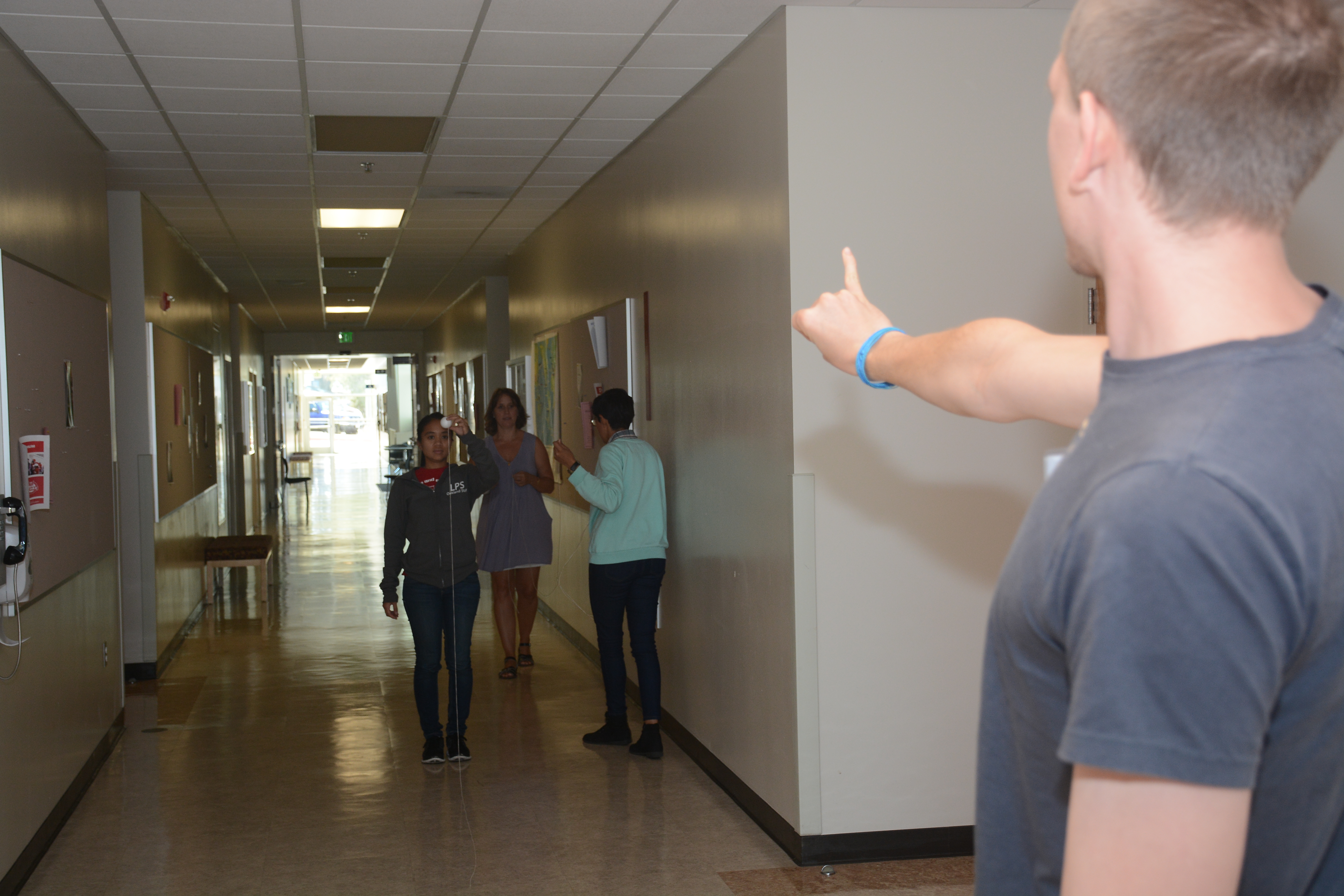
Angular separation and angular diameter are important measurements in astronomy in defining the position and apparent size of celestial objects.  Backyard astronomers, and learners without sophisticated equipment, can make approximate measures of either using their hands as measuring tools. An open hand with outstretched pinkie finger and thumb describes about a 20° arc; a closed fist 10°; and an extended pinkie about 1°.  When applied to the full Moon, it is discovered it has an approximate angular diameter of half a pinkie, or half a degree.

Solar system scaling activities are a staple of most any astronomy professional development for educators.  While there are many variations, the most basic has to do with the Earth-Moon system. With a diameter ratio between the two bodies of approximately 4:1, it is easy to model the system with four-inch, and one-inch polystyrene balls.  Approximating the Earth-Moon distance as 240,000 miles, and an Earth circumference of 24,000 miles, it is easy to wrap some twine around the Earth ball ten times to find the distance to the model Moon. Due to the principal of similar triangles, the model Moon, when viewed from the position of the model Earth, will present an angular diameter of half-a-degree, or half a pinkie!  A good test of the relative accuracy of a learner’s model of the system.

Once a learner creates their scale model of the Earth-Moon system, it is an easy extension to include Mars and investigate where to place the model planet so it presents the same angular diameter as the Moon.  With a diameter approximately half that of Earth, a two-inch polystyrene ball can represent the Red Planet. Learners can then place the model Mars in a position where it visually appears to have the same diameter as the model Moon, discovering it is twice as far away from Earth as the Moon: about 500,000 miles!  Much closer than the closest approach on July 31, 2018 when Mars comes to within 35.8 million miles. Asking the learner to find the actual position of their model Mars relative to the Earth, they discover they need to place it between a quarter and a third of a mile away at about 1,566 feet from their model Earth!  They can then attempt to measure their model Mars’ angular diameter, a good task for a Galileoscope, based on knowing the angular field of view of its eyepiece.

Viewing the phenomenon of a close Mars opposition can provide a magnificent opportunity for learners new to astronomy to participate in science practices, engaging in evidence-based reasoning and modeling.  Applied in a manner where learners discover for themselves the size-distance relationships, the experience may provide a powerful deterrent for the next iteration of the Mars hoax.

A version of this post first appeared in the Summer 2018 edition of Mercury Magazine, a publication of the Astronomical Society of the Pacific.
Posted in Uncategorized | Leave a comment