Learning to See

This past August, I had eye surgery, an event giving me a renewed appreciation for what our brains are capable of, and their elasticity in accommodating and assimilating sensory input as well as ideas. My recovery reminded me of the film shown in many classes in the 1960s, where a researcher wore a set of glasses that caused the world to appear upside down. Within a few days, the researcher’s brain inverted the image and the world once again appeared right side up. A couple of days later the glasses came off, and everything again was upside down, and eventually the researcher again perceived the world as before the experiment. It takes babies several weeks for their brains to learn how to fuse the inputs from each eye into a single image.

In my case, a defect in my eye muscles caused them to not work properly, creating a misalignment of my eyes. The misalignment was great enough that my brain couldn’t compensate for the difference, resulting in some double vision. Minor surgery was successful at correcting my muscular imbalance, aligning my eyes so my brain is able to fuse the input from both eyes into a single image. But the fusing of these images following surgery was not instantaneous, and took several weeks for my brain to relearn how to see and completely restore my singular perception of the world. As with babies, the ability to track moving objects took longer to redevelop.

The restoration of my sight is somewhat analogous to what educators do when confronted with a learner’s lack of understanding, and perhaps misconception of scientific principles and/or natural phenomena.

An in depth understanding, and ability to thoroughly explain phenomena requires time and multiple opportunities to practice, with sustained contact with the concept over many days if not weeks. As with any learner, effective teacher professional development related to natural phenomena should include reinforcement over time.

In the case of solar and lunar eclipses, one could show someone a diagram and explain the phenomena in words, which a learner could, in all likelihood recite verbatim back to the explainer. However, really owning the concept through cognitive accommodation and assimilation takes time and an awareness of a suite of background concepts and phenomena including: Earth’s (and the Moon’s) rotation and revolution, and their relationship to how time is measured; shadows and light, particularly the kind of shadow cast by a spherical object illuminated by a single, point source; the measurement of angular size; size and distance scale of the Earth and Moon; the frequency and pattern of lunar phases; and the frequency and pattern of lunar and solar eclipses, and their relationship to lunar phases. The learning of any one aspect of eclipse phenomena is akin to keeping one eye closed when looking at a distant object. The depth of understanding is lost, much as binocular vision is necessary for visual depth perception. A misconception, such as lunar phases are the Moon passing into Earth’s shadow, or the Moon really is larger when it rises is similar to having both eyes open but with each eye gazing in a slightly different direction. The brain may pay greater attention to one image while relegating the other as an annoyance safely ignored. Unfortunately, many misconceptions offer a stronger, and perhaps more intuitive appeal, until the learner is confronted with evidence with which to dispel the misconception. It is in the fusing of all the experiences where in-depth learning and integration of a concept takes place.

As mentioned in previous Education Matters columns, the Next Generation Science Standards have provided a marvelous framework for engaging learners in the sorts of in-depth investigations necessary for fully understanding eclipses. Through the use of a storyline approach, educators can actively engage learners in each of the essential background concepts mentioned above. Using resources developed for ASP programs the Night Sky Network, Project ASTRO, and Astronomy from the Ground Up, ASP staff have created such a storyline and are using it in workshops to help educators prepare for next year.

The total solar eclipse on August 21, 2017 is a teachable moment without compare. Taking place mid-day, on a day when many schools throughout the country are in session, it is an opportunity for educators, in and out of the classroom, to engage learners of all ages in experiences with both eyes open, both literally and metaphorically, promoting a full understanding of a phenomena that has caused wonder and bafflement for millennia.

This post originally appeared as the Education Matters column in the fall 2016 issue of the ASP’s Mercury magazine.

Posted in Uncategorized | 1 Comment

It’s Elementary

Recently, The National Academies Press published Science Teachers’ Learning (NAP, 2015), a report on the current state of science teacher preparation, along with recommendations for approaching how and when teachers engage in professional development, and the necessary changes to education policy influencing those opportunities. I became aware of this new resource at the 2016 NSTA National Conference on Science Education in Nashville, Tennessee, when Dr. Julie Luft, a member of the committee that worked on the report, gave a presentation to a joint meeting of the National Science Education Leadership Association (NSELA) and the Association for Science Teacher Education (ASTE). In her talk, Dr. Luft presented some sobering, but not surprising, statistics from the report: during a three year period, 41% of elementary teachers participated in no science related professional development (PD). And only 12% participated in the equivalent of one day of science related PD during the same three-year period. This is in stark contrast to the 18% of middle school, and 15% of high school teachers who did not engage in science related PD. 47% of middle school science teachers, and 57% of those in high school participated in at least one day of science PD per year during the same time.

Elementary teachers are particularly challenged compared to their secondary colleagues due in large part to their teaching multiple subjects, particularly math and language arts, which are emphasized due to their prominence in the high-stakes testing that has influenced education policies since the implementation of No Child Left Behind. As a result of these policies, studies cited in the NAP report indicate only 19% of K-2 classrooms, and 30% of those in grades 3-5 receive science instruction on a daily basis. When science is offered, it only accounts for an average of 19 minutes per day in grades K-3, compared to 54 minutes for math, and 89 minutes per day in language arts. Grade 4-6 classes show a slight increase to 24 minutes per day for science instruction. These short time spans for science results in learners making few connections between the instruction and developing a rudimentary understanding of basic scientific concepts. Even in classrooms where science takes a greater role, elementary teachers are generally unprepared to develop learning opportunities for their students, let alone implement them. While teaching basic scientific concepts requires a different skill set and knowledge base than that required for engaging in scientific research, few teacher preparation programs provide adequate opportunities for acquiring the relevant pedagogical content knowledge. Only 5% of elementary teachers majored in a science-related field, about the same as the 6% who took no college science courses.

As noted in previous Education Matters columns, from time to time I visit science methods classes in teacher preparation programs at local universities. I also have interacted with inservice elementary teachers during teacher resource fairs, and professional development workshops delivered at the Astronomical Society of the Pacific. While many of the elementary teachers I come in contact with have a relatively sophisticated understanding of science, a large number of the early elementary teachers I have spoken with demonstrate the opposite. One first grade teacher in particular described how he incorporated the scientific method in activities, with students conducting controlled experiments. During our conversation, we discussed how the scientific method is a myth, and how there are a great many ways of doing science. Much of biology, as well as earth and space science do not conduct controlled experiments, and rely on observation, prediction, and modeling to arrive at conclusions. A more developmentally appropriate approach for engaging a first grader involves emphasizing questioning, and making observations to recognize and describe patterns. The ability to control variables is cognitively available for somewhat older learners.

A Framework for K-12 Science Education (NAP, 2011), and the subsequent Next Generation Science Standards (NAP, 2013), set the stage for significant changes in how teachers, including those at the elementary level, will approach their curricular and instructional decisions. Teacher preparation programs, as well as professional development providers (including the Astroteacher and the Astronomical Society of the Pacific) are in the process of redeveloping their offerings to reflect these changes. The emphasis on student engagement in the practices of science, and reasoning from evidence requires a better understanding on the part of implementing teachers of both the core ideas and concepts of science, and their application during active investigations through the use of the practices. The implication of the report, and efforts to fully implement the philosophy laid out in the Framework, is the dearth of science instruction in elementary grades must, and will increase. To accomplish this, the frequency and quality of teacher learning must also change.

Note: This post originally appeared as the Summer 2016 Education Matters column in the ASP published Mercury magazine.  The author serves as the Region F Director for the National Science Education Leadership Association (NSELA).

Posted in Uncategorized | Leave a comment

Evoking a Sense of Awe

“Our ancestors worshiped the Sun, and they were far from foolish.  And yet the Sun is an ordinary, even a mediocre star.  If we must worship a power greater than ourselves, does it not make sense to revere the Sun and stars?  Hidden within every astronomical investigation, sometimes so deeply buried that the research himself (sic) is unaware of its presence, lies a kernel of awe.”

-Carl Sagan, Cosmos

In their quest to understand and explain the natural phenomena they experienced on a daily basis, our ancestors told stories, many of which became the myths and legends with their pantheon of gods.  Objects such as the Sun and Moon, as well as more earthly places such as the seas and volcanoes, were the manifestations of the unseen beings behind the phenomena.  Monuments and cathedrals were built to honor these deities, while providing a place in which to worship.

In our modern age, scientists have explained the vast majority of the phenomena formerly attributed to magical or supernatural beings.  In one way the practice of science has led to the creation of new edifices, the instruments with which scientists undertake their investigations.  Astronomers have a particularly visible set of instruments, the observatories whose domes grace mountaintops in many places around the world, as well as in orbit above the obscuring effects of Earth’s atmosphere.  Kitt Peak is one such place.

DSC_3720

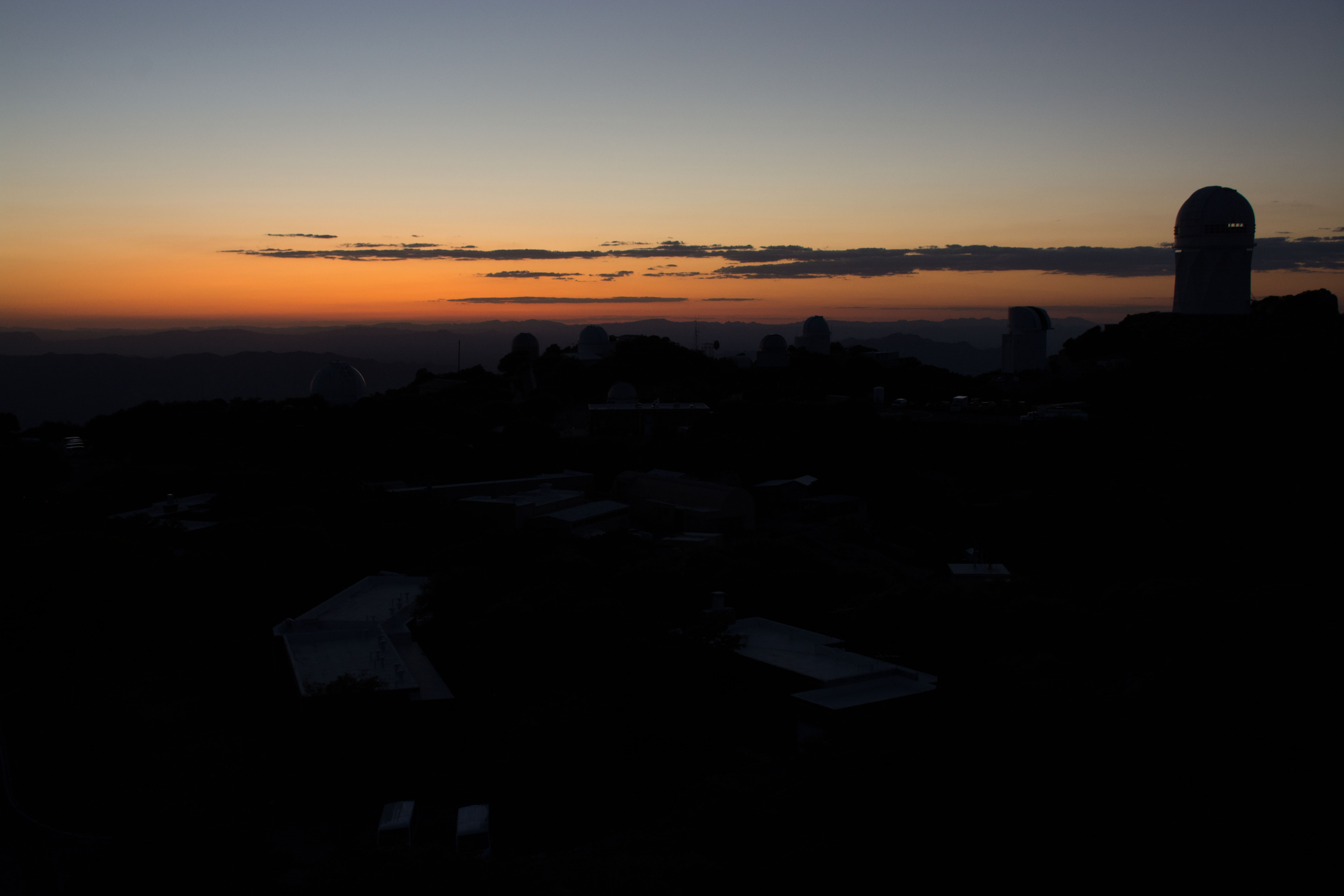
Kitt Peak National Observatory from the gallery of the Mayall 4-meter telescope.  Baboquivari Peak, the center of Tohono O’odham cosmology and home to their creator, I’itoi, rises in the distance.

Located on the second most sacred peak to the Tohono O’odham people, Kitt Peak features over two dozen optical and radio telescopes.  The largest instrument is the Mayall 4-meter telescope, and most iconic is the 1.6-meter McMath-Pierce solar telescope.

DSC_3736

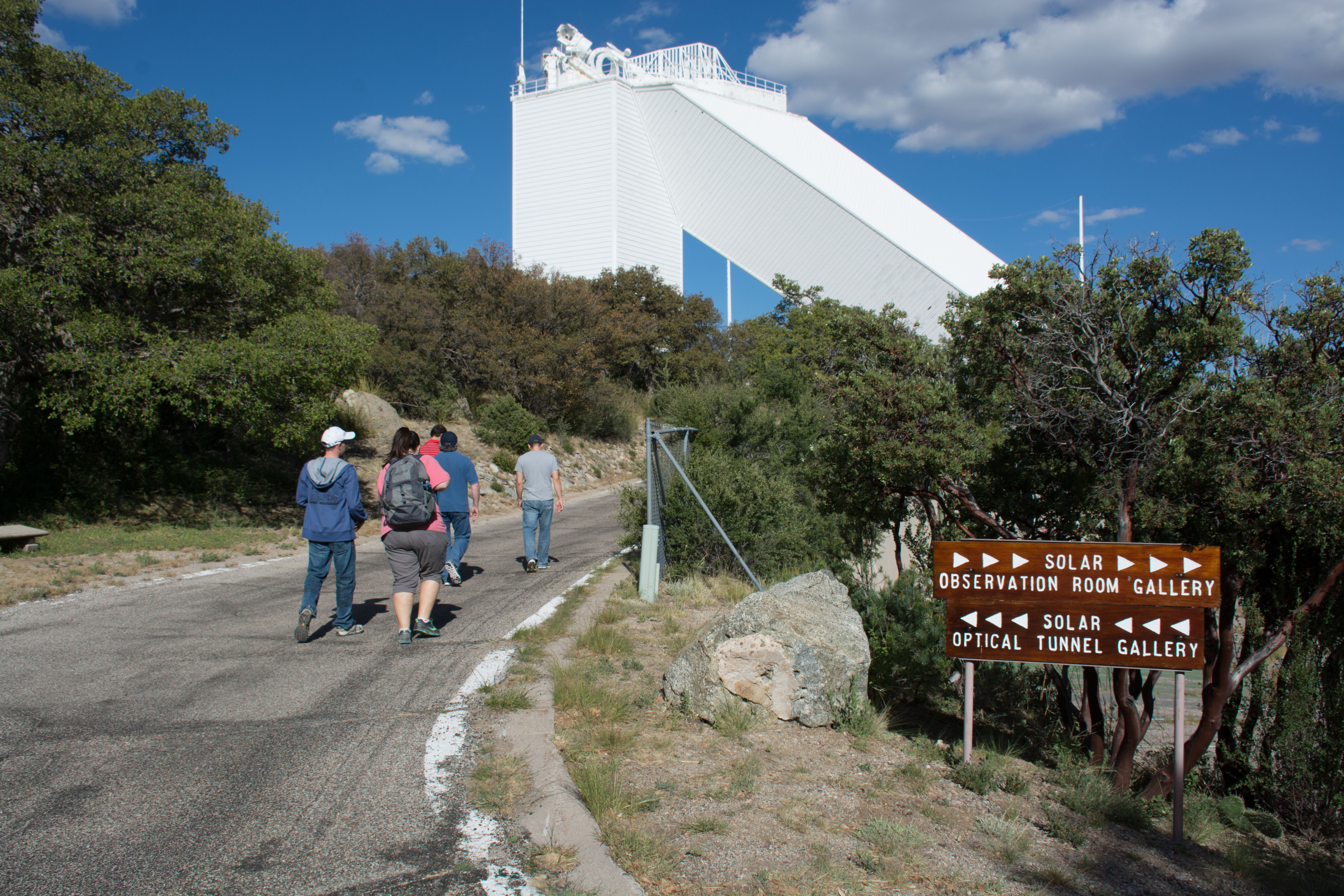
Walking towards the McMath-Pierce solar telescope.

DSC_3741

Earlier this month, as a part of the Project ASTRO National Network annual Site Leaders Meeting, a group of us visited Kitt Peak.  The highlight of the tour was a visit to the solar telescope, and the opportunity to watch sunset on a projected image of the Sun, watching as clouds obscured the solar disc, and as it dropped behind a distant range of mountains.  It was an amazing spectacle.

DSC_3778

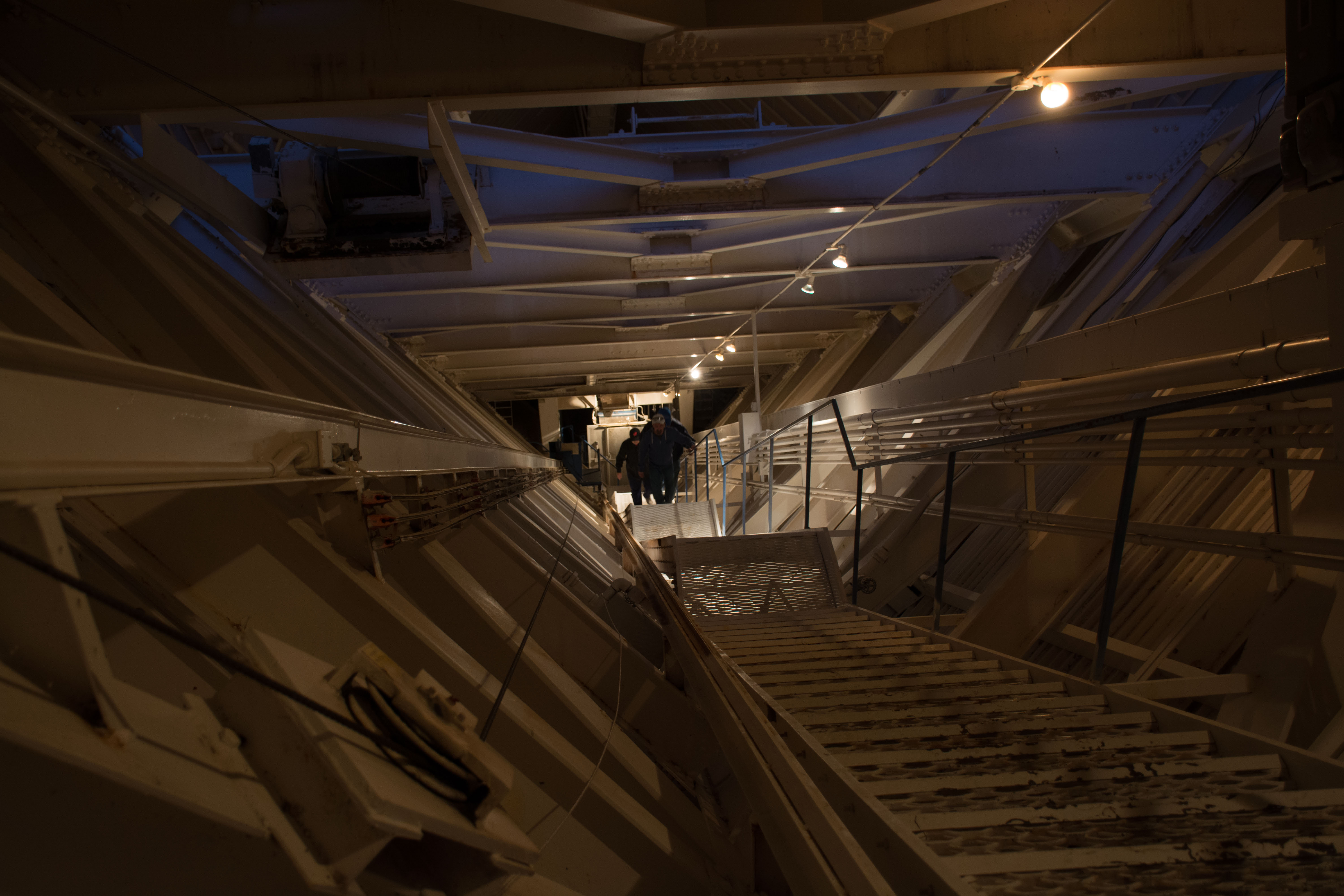
After sunset, the researcher operating the telescope asked us if we wanted to go up to the top.  Of course we said yes!  And were treated to a view from a hundred feet above the ground.

mcmath_sch

Schematic of the McMath-Pierce Solar Telescope. Image: NOAO

DSC_3786

Climbing the stairs inside the superstructure.

DSC_3789

Looking down the optical tunnel from the top.

DSC_3806

The heliostat at the top of the telescope.

DSC_3800

DSC_3797

DSC_3793

The tall dome to the right houses the Mayall 4-meter telescope.

In many ways our society takes the Sun for granted.  Astronomers, and particularly those who study the Sun, know better.  They are granted a front row seat to a spectacle inspiring awe in anyone fortunate enough to gaze on the phenomena with open eyes and mind.

Posted in Astronomy | Leave a comment

Thinking About Space

The advent of the personal computer and the Worldwide Web revolutionized the way we interact with each other, and information about, well about everything. A cliché, without a doubt. From an educational standpoint, these virtual interactions have yet to fulfill their promise, with many of them little more than novelties and games. Computers have provided innovative means to collect and analyze data in the classroom, to access data online, and to change the parameters in simulations to better understand the relationships between variables. A common limitation of these activities is the learner remains passive, observing what is taking place, or simply acquiring information. It is the rare program or website that truly provides a dynamic environment for learners to actively engage in manipulating a scenario and making sense out of phenomena. Desktop planetarium software does provide the ability to navigate through space and time with relative ease; however, in many ways, it is more suited to acquiring data for historic or future astronomical events. The folks at the Harvard-Smithsonian Center for Astrophysics (CfA) are out to change this, creating a virtual environment for learners to engage in inquiry about a variety of astronomical phenomena through the Worldwide Telescope (WWT), an astronomy visualization program created by Microsoft Research, and now an open source program hosted by the American Astronomical Society.

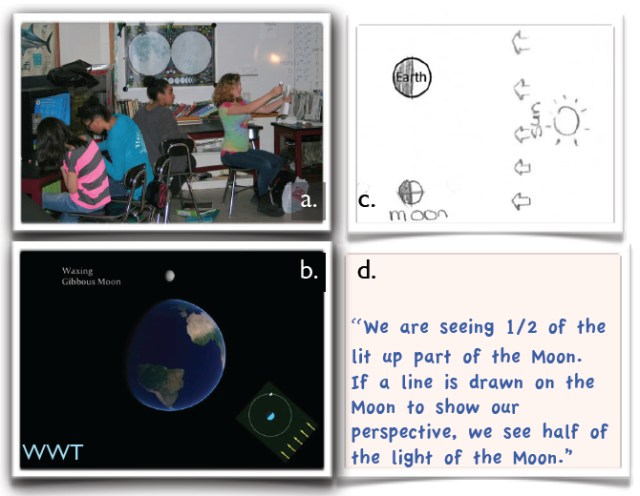
For a number of years, the WWT Ambassadors team, led by Alyssa Goodman and Patricia Udomprasert, has tested the efficacy of WWT as a platform for inquiry. An NSF EAGER grant allowed them to collect data to demonstrate its potential, resulting in a larger DRK-12 development grant to produce a series of modules utilizing guided inquiry to teach about astronomical phenomena and spatial thinking. One finding from their initial research is how WWT as a learning tool is particularly effective when combined with activities where learners physically manipulate objects to model the phenomena they are investigating in WWT. It turns out the learners develop a more accurate, and durable mental model of the phenomena when using both tools together than with either in isolation.

This has some profound implications for education in general, particularly when it comes to providing opportunities for learners to develop their spatial thinking. Co-Principal Investigator Julia Plummer (Pennsylvania State University) of the DRK-12 project says: “One of the main issues in spatial thinking in astronomy is learning to visualize both static and dynamic objects and systems and then imagine how those objects or systems would look from different perspectives.” In traditional astronomy teaching, static images are frequently used to represent dynamic phenomena, without providing learners enough support to allow them to construct a mental model of the phenomena. The WWT-based labs designed by the WWT Ambassadors team allow learners to move around within the visualization, observing the phenomena from a variety of perspectives. Combined with physical manipulation of objects through modeling of the phenomena, learners are able to undertake spatial transformations, shifting their perspective in real time, thus providing a greater amount of information for their construction of a mental model to explain the actual phenomena.

wwt screen shot copy

Image courtesy Patricia Udomprasert and the WWT Ambassadors team

In general, astronomy has been hampered with an inability to run direct investigations on distant phenomena. We can only observe, and infer through modeling what is occurring. Translated into a learning environment, astronomy does not fit into the neat sequence of the “scientific method” as taught in the majority of classrooms. Astronomy does, however, provide a rich milieu for incorporating modeling into the learning environment, with the opportunity to develop spatial thinking skills with wider application for learners not only in the study of science, but for life skills in general. Platforms and dynamic visualization environments, such as those under development at CfA, will hopefully serve to move the use of computers and online resources away from mere information gathering tools for passive learners, towards model-building simulators, where learners actively investigate phenomena to build their own mental models of how the universe operates.

To learn more about the Worldwide Telescope, go to http://wwtambassadors.org/thinkspace-labs

This post originally appeared as the Education Matters column in the Spring 2016 issue of Mercury Magazine, published by the Astronomical Society of the Pacific.  The author serves on the advisory panel for the ThinkSpace Labs project.

Posted in Astronomy, Education Matters, Science Education | Leave a comment