A Pilgrimage to a Volcano

At approximately 8:30am on Sunday, May 18, 1980, I unexpectedly woke from a sound sleep.  At the time it seemed odd I woke at that particular time.  As the morning progressed, it was evident many others around western Washington state noted the sound of a large explosion at the same time.  While I have no memory of any sounds, it is almost certain my waking was in response to the eruption of Mt. St. Helens, about 100 miles to the south.  For the rest of the day, I watched the news, with updates on the massive eruption.  My parents, in East Wenatchee, Washington, were on the edge of the resulting ash cloud, as well as for subsequent eruptions.

It wasn’t until the summer of 1982 when I got my first good look at the mountain.  Working as a field assistant for Paul Hammond, a Portland State University geology professor, we were mapping lava flows in the Indian Heaven area between Mt. Adams and Mt. St. Helens.  The area was newly removed from the red zone around Mt. St. Helens, and the USGS, who was supporting our work, were interested in investigating the history of volcanic eruptions in the region in greater detail.  Out of the crater came a constant plume of steam and ash, with periodic larger pulses.

In 1987, the US Forest Service reopened the mountain for climbing.  A group of us took advantage, and ascended the truncated peak on July 25, 1987.  While not a technically difficult climb, the route follows the Monitor Ridge lava flow, then on to the ash and pumice covered upper slopes.  A second climb, on July 8, 1988, provided a contrasting experience.  More snow in 1988 made for an easier climb, as did a smaller group more interested in looking at the geology of the mountain, rather than the novelty of the experience.  The second group included my undergraduate geology professor, Edwin Olson, and fellow geologist Gary Paukert, along with Barb Paukert, and Peter, a friend of Ed’s from Switzerland.

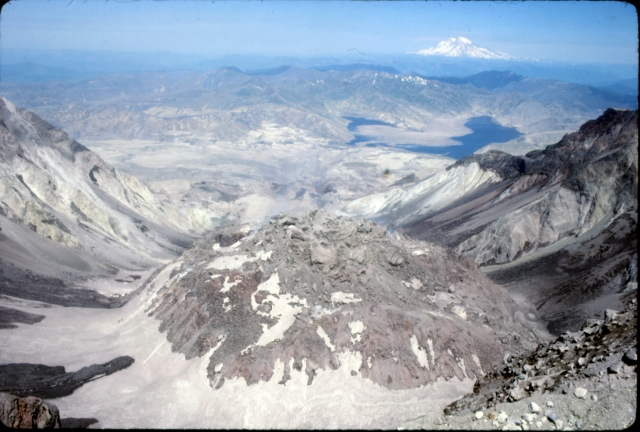
The view from the summit was astounding!  While in 1987 the crater was filled with clouds, presenting only glimpses of the dome, 1988 was clear, with views north to Spirit Lake, and beyond to Mt. Rainier.
IMG_0025

The following year presented what was, at the time, a unique opportunity.  Returning to Portland from a wedding in Spokane, I was told if I wanted to go on a field trip to Mt. St. Helens with Paul Hammond, along with USGS geologist Donald Swanson, I should show up at the meet up spot at Portland State at 4:30am the next morning.  So, on September 24, 1989, I found myself on a hike into the closed areas north of the volcano, eventually climbing up into the crater, and on to the lower slopes of the dome.  Along the way, we crossed the desolation of the pumice plain, examined the surfaces of pyroclastic flows, and explored newly incised canyons in the debris filling the northern breach of the crater.  A new waterfall, Loowit Falls, with water flowing out of the upper reaches of the crater, and canyon wrens newly resident calling from the surrounding cliffs.

Into the crater…
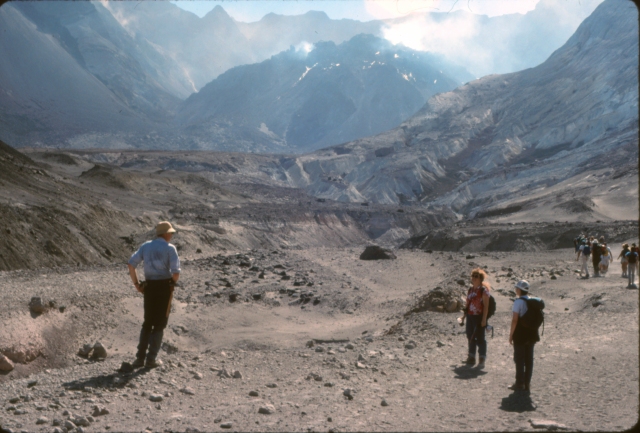
IMG_0001

Many years passed, as I found myself living far from the mountain.  In June 2018, the opportunity presented itself to revisit Mt. St. Helens, venturing up the road to the visitor center on Coldwater Ridge.  A hike to Harry’s Ridge brought back memories of thirty years before, when annual pilgrimages to the mountain were a regular occurrence.

The changes in the mountain, and surrounding areas are tremendous.  Life has regained a foothold, with green covering the slopes which once were a uniform gray and brown, devoid of plants.  Trails now take people into areas once off limits, and it is no longer a novelty to find oneself in the midst of a volcanic landscape.  Though it does give one pause, as most visitors see the volcano as inactive and benign.  With the eye of geologist, with a different appreciation for time, this is just a brief interlude in the continuing process of volcanism.  An interlude where life and erosion hold court.  In time, a short time to a geologist, Mt. St. Helens, and the other quiet volcanoes of the Cascade Range, will erupt again.  Destroying, and renewing the landscape, a testament to the dynamic planet we live on.

In some ways, we owe our very existence to volcanoes, as they replenish the atmosphere with essential gases, an important step in the ongoing global recycling mechanism called plate tectonics.  Some astrobiologists and planetary geologists even go so far to suggest the presence of plate tectonics is a limiting characteristic of planets for the presence of life.  Something to reflect on the next time you hear of a destructive volcanic eruption.  Perhaps better to think of it as a constructive event, ensuring the habitability of the Earth, the only home our species has.
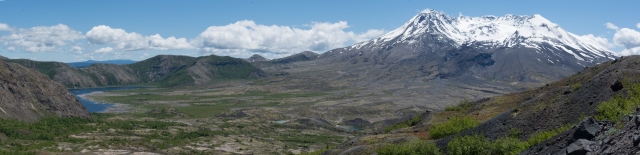
DSC_1011-Pano

Posted in Earth History, Uncategorized | 1 Comment

The Centrality of Phenomena

The quest for relevance and equity in science education

Those of us who work in science education and outreach, including the staff at the Astronomical Society of the Pacific, do so out of a sense of hope and belief our efforts make a difference in the lives of learners of all ages. At times that hope takes a hit when we hear about the wide range of discredited ideas and misconceptions people hold.

With the amount of evidence available, one would think the contentions the moon landings are a hoax, the earth is flat, that a dark planet is set to collide with the earth, or a periodic alignment of planets is somehow rare and a portent of doom, would have disappeared for good. Over the past year or so, all of these have reappeared in a variety of news media, raising fears amongst those who are uncertain of who to trust, and consternation from educators and scientists who thought the last time they debunked these ideas was indeed, the last time.

Much discussion has taken place about how to address ideas and misconceptions such as these, some of it in past posts of this blog. Experts and commentators acknowledge it is a difficult thing to change someone’s core beliefs, and the presentation of facts and evidence may only serve to further entrench the belief. It seems as though some sort of transformative experience is required for those who have held their ideas for a long period of time. For younger learners, ensuring they have access to an education which promotes collecting and reasoning about evidence, and the communication of evidence-based explanations of natural phenomena may serve to create a culture where ideas at odds with the evidence fail to find fertile minds in which to grow.

The current transformation of science education places an emphasis on learner investigations of compelling natural phenomena, rather than the traditional curriculum of teaching a series of topics. The establishment of an anchoring phenomenon leading to a driving question that guides a series of student investigations where they incrementally build an evidence-based model for the phenomenon in some ways is a more accurate portrayal of how science works, rather than the traditional sequence of the “scientific method.”

So, why the focus on phenomena rather than a set of core topics? In short, because it helps make science education more relevant and equitable for students. For most of human history, people have attempted to explain the natural phenomena they found themselves immersed in. It was relevant to them to discover something about the nature of shadows, and how different materials affected a beam of light. It was relevant to utilize the patterns they observed in the day and night skies to navigate, or to know when they should plant crops, or hunt, or get ready for a time when resources were scarce. For many people in our modern society, these past explorations and explanations are irrelevant, and perhaps even contrary to what they believe. The suggestion is if they can make a personal observation to share with everyone else it is more valid than those made in the past as a scientific explanation of the universe was under development. In other words, it is their personal experience of a particular phenomenon that is paramount and trustworthy.

“The most powerful phenomena from an educational perspective are culturally or personally relevant or consequential to students.” and “A good phenomenon builds on everyday or family experiences: who students are, what they do, where they come from.” (http://stemteachingtools.org/assets/landscapes/STT42_Using_Phenomena_in_NGSS.pdf) Students are more apt to engage productively with, and incorporate a scientific explanation for a phenomenon when they feel a sense of connection. A further implication for the centrality of phenomena in science instruction is it makes the science more accessible to learners, and more equitable, supporting the engagement of all.

Creating science educational experiences for young learners centered on phenomena may provide the means for ending the recurring cycle of false ideas and misconceptions. When confronted with eternal recurrence, Zarathustra reacted with nausea. As science educators, we would like nothing more than to not cover old ground time and again.

A version of this post first appeared as the Education Matters column in the Winter 2017 edition of Mercury Magazine, a publication of the Astronomical Society of the Pacific.

Posted in Education Matters, Science Education | 1 Comment

Standing in the Shadow of the Moon

For two years and more, the total solar eclipse of August 21, 2017 consumed my life.  From writing and rewriting activities designed to teach about the eclipse, delivering numerous professional development sessions and workshops to teachers around the country, planning and hosting webinars, and caring for a growing cadre of volunteer photographers from coast to coast, it seemed like all eclipse, all the time.  In early July, I was burned out, and could not wait for August 22 to dawn, with no eclipse to look forward to, or activities to facilitate.

When I arrived at the Oregon Star Party, in the path of totality 45 miles east of Prineville, Oregon, all I wanted to do was hang out in the quiet.  The smell of junipers, and the sight of mountain bluebirds on the drive into the Ochoco Mountains helped improve my mood, perhaps because they had nothing to do with the eclipse, and they were a reminder of the beauty of the high desert.

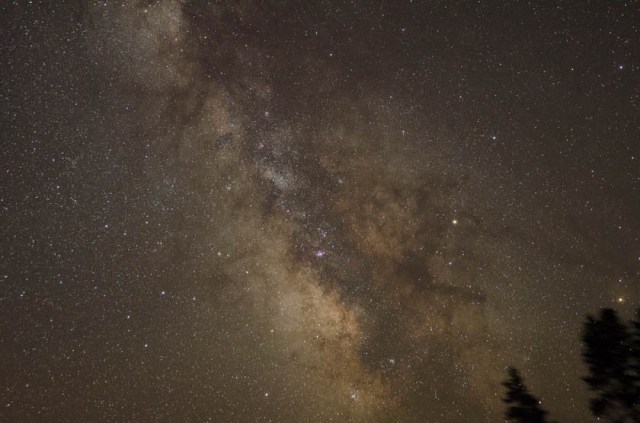
The night sky in the Ochoco Mountains is usually pristine, where on a good night the Milky Way will stretch from horizon to horizon, and up to a dozen deep sky Messier objects are visible to the naked eye.  For me it is usually enough to sit back and gaze into the depths of time and space, the telescope left unused.

20170816-D7K_8508

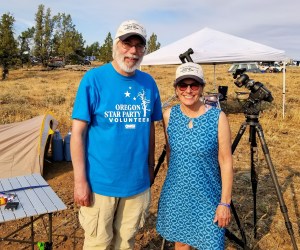
During a stint volunteering in the information tent, a woman came in and exclaimed “I know you, you’re the Megamovie guy, you’re famous!”  And so I met Catherine Roberts.  The Eclipse Megamovie is a project where the Astronomical Society of the Pacific partnered with the UC Berkeley Space Science Lab, and Google to produce a movie of the total eclipse from coast to coast.  Using volunteer photographers with a variety of skill levels and equipment, the ASP’s role was to recruit, care for, and train what became a cadre of over 1,400 volunteers.  Catherine was one of these volunteers.  Later that afternoon, we discussed the settings to use on her cameras, and thus on my own.  It was a simple thing, however meeting Catherine, and her enthusiasm, did wonders for my own excitement level, as once again I started looking forward to the eclipse.

Catherine Roberts at OSP

Catherine Roberts and the author at the 2017 Oregon Star Party

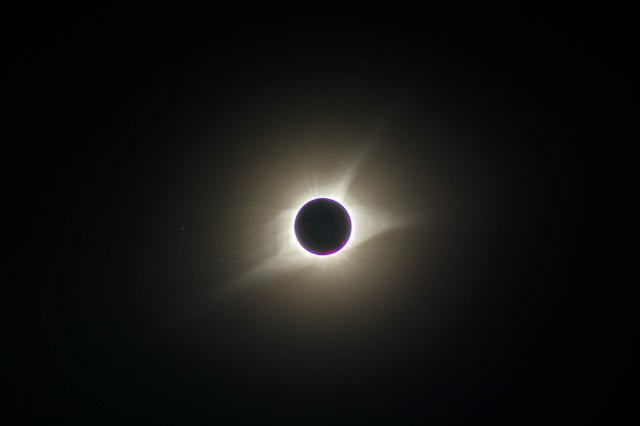
An evening of dense smoke, and another with clouds obscuring the sky, had everyone concerned the eclipse would prove elusive to our observations.  Monday, August 21 dawned with a thin haze of smoke and a few clouds along the horizon.  Everyone arose and set up their equipment in the hope of seeing the phenomenon we had all traveled so far to see, putting up with washboard gravel roads, and a dusty landscape reminiscent of Mars, the topic of my Saturday evening talk to the gathered astronomers.  At first contact, whoops and shouts of joy rose into the sky, greeting the beginning of the eclipse.  As the partial eclipse deepened, anticipation rose, until finally, with a flash of the diamond ring, the solar corona sprang into our awareness.

five bracket blend (1 of 1)

Words are insufficient to describe what we saw with our unshielded eyes.  After an all too short 83 seconds, another instance of the diamond ring, and totality was at an end.  With an hour of waning partial eclipse ahead of us, my neighbor Rob brought me a can of Chromosphere Ale from Ecliptic Brewery to celebrate.

It was a marvelous experience to share standing in the shadow of the Moon with so many like-minded people on a barren ridge high in the Ochoco Mountains.  A phenomenon like a solar eclipse is, as someone once said, the most democratic of experiences, where everyone shares in a collective experience of awe at the stunning beauty of what looks like a hole in the sky.  It is no wonder the ancients worshiped the Sun, inventing all manner of myths and deities to explain an eclipse when their mind has lost its ability to do so rationally.

20170820-D7K_9406-2

And the Eclipse Megamovie?  Tens of thousands images from the majority of the volunteers, including Catherine Roberts and the author, is producing something marvelous.  Its story is compelling in its own right.

Posted in Uncategorized | 4 Comments

Astronomical Phenomena as a Provocación for Learner Engagement

The total solar eclipse taking place on August 21, 2017 is a natural phenomenon on a grand scale. Though only those on the narrow swath cutting across the country from Oregon to South Carolina will see totality, everyone throughout the entire rest of the North American continent will have the potential to see a partial eclipse. One of the more remarkable aspects of this eclipse is it is taking place during normal school hours, on a day when many, if not most schools across the country are in session. For many it is the first day of school for the year. This creates for educators a teachable moment without compare, providing an opportunity to engage learners in investigating, and explaining using evidence-based reasoning this spectacular phenomenon in the sky.

So, what to do when the excitement fades and there isn’t an easily accessible phenomenon for students to experience directly? How do educators keep the momentum going? For most of the sciences, it is relatively easy to demonstrate phenomena in the classroom, or to point to something learners experience in their daily lives, thus actively engaging them in a scientific investigation. Other than an eclipse, what astronomical phenomena are learners able to experience first hand or can relate to in their own lives? The phases of the moon, and the seasons are perhaps the easiest to experience and investigate, and maybe tracking the brighter planets as they change position from night to night. Noticing that not all stars are the same color, or the same brightness is a good one, though the patterns they make in constellations and asterisms are less valuable since those patterns are not inherent to any scientific processes learners can investigate.

The truth of the matter is, most astronomical phenomena are not accessible to learners, or useful for engaging them in an active, inquiry-based classroom investigation. It isn’t that the phenomena are lacking interest for the learners, they just don’t rise to the level of a teacher posing a problem such as: “It rained last night and you noticed there were puddles of water on the playground when you got to school. When you left at the end of the day, the puddles were gone. Where did the water go?” This lack of relationship to a teacher or learner’s normal, everyday life may help explain why astronomy and space science are traditionally underrepresented in curricula and classroom instruction.

In the presence of a robust program of space exploration, particularly if humans are involved, space science instruction is able to utilize various missions as an engagement into an investigation. This works well if the phenomena under investigation bears some similarity to our experience on Earth, or has to do with the potential for life elsewhere. For example, Mars exploration is a popular subject leading to a variety of classroom experiences, possibly due to the similarity of Mars to Earth, the long history of speculation about life on Mars, and the potential for an eventual human on what is arguably the most fascinating object in the solar system beyond Earth. This use of what we might call analogous phenomena is worthwhile in that they create an indirect experience and relevance for learners. Moving to phenomena beyond the solar system presents a unique difficulty to the science educator due to their remote nature and lack of easily identifiable analogous phenomena. For example, one of the performance expectations for middle school learners in the Next Generation Science Standards (NGSS) says “Students who demonstrate understanding can: Develop and use a model to describe the role of gravity in the motions within galaxies and the solar system.” Investigating gravity within the classroom is easily accomplished, however it can prove problematic when extended beyond to the solar system, and further to galaxies. It requires greater abstractions than many learners are able to handle. They are not able to directly observe and experience the motions, and have to infer them based on changes in position of the planets. On human time scales, motion within galaxies is less available, requiring more direct instruction from educator to learner, thus taking the investigation away from the learner-directed or educator-guided inquiry called for in the three-dimensional learning environment of an NGSS classroom.

STSCI-HST-abell370_1797x2000

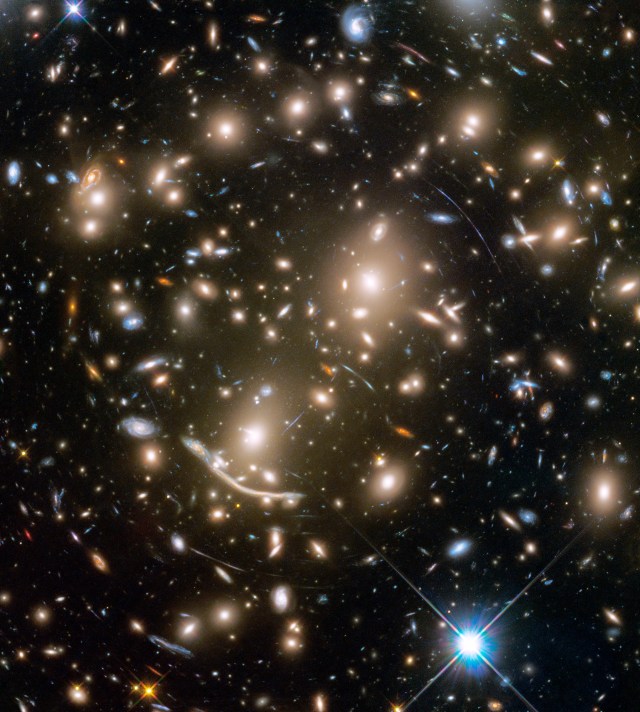
Galaxy Cluster Abell 370 and Beyond Image Credit: NASA, ESA, Jennifer Lotz and the HFF Team (STScI)

This is an important challenge to astronomy and space science educators, to develop a rationale and identify a suite of astronomical phenomena educators can incorporate into their instruction. Imagery of distant galaxies and nebulae are stunning in their ability to show us what the universe looks like. Identifying the phenomena they display and we want learners to investigate is much more difficult. This year’s solar eclipse is perhaps setting the stage for a resurgence in space science in the classroom. It is our task to make sure the learners have something to pique their interest, a suitable provocación to engage them in the wonders of the universe.

This post originally appeared as the Education Matters column in the Summer 2017 issue of Mercury magazine, a publication of the Astronomical Society of the Pacific.

Posted in Uncategorized | 1 Comment