Looking Afar to See Ourselves

Assimilating and accommodating new ideas and ways to do things is not always an easy task. Sometimes we find ourselves too close to old and comfortable ideas, unable to find a perspective from which to evaluate the potential for the new. For learners of all ages, it is a challenge to help them shift their perspective to see how the new can fit with their existing worldview. The problem is not so much what is presented, as with how. Sometimes finding the new perspective requires a trip beyond the confines of the planet we think we know so well.

Two areas of science in particular are not well understood for the general public at large, as well as many teachers and their students: evolution and climate change. All too often, both topics are presented pedantically through a series of lectures, exercises depending on rote memorization, and perhaps a few activities with pre-determined outcomes, which do little to help students build a conceptual framework for either to fit into their basic understanding of how nature operates. This can only add to the difficulties many have accepting either or both evolution and climate science. Other areas of science do not seem to share the same disdain many people have for these particular ideas.

Part of the problem has to do with time. Time in that an understanding of both evolution and climate change require an acceptance, and ability to think about change over a time scale far greater than what people experience in their daily lives, let alone over the span of a lifetime. For the most part, we lead existential lives, moment to moment, with little thought beyond our current experience. The idea of deep time so prevalent in much of astronomy, and certainly in geology and evolutionary science, does not resonate with the average person.

In general, people are fascinated with the idea of aliens, the discovery of planets orbiting distant stars, and the exploration of planets within our own solar system. The idea life might exist on those planets piques the intrigue people feel when hearing about them. Particularly the kind of life that could look back at our system of planets and wonder the same thing. In thinking about the potential for life on these other worlds, again, people seem to have a tendency to think of that life existing in the here and now. It is equally possible these planets once had life, which went extinct, or it may more closely resemble stromatolites from early in Earth’s history with intelligence perhaps in the planet’s future. Within our own solar system Mars, while in the habitable zone, does not have life though it may have in the distant past. Venus is on the edge of the habitable zone, though a runaway greenhouse effect made for an inhospitably hot atmosphere. Neither planet currently possesses an atmosphere capable of supporting life as we know it.
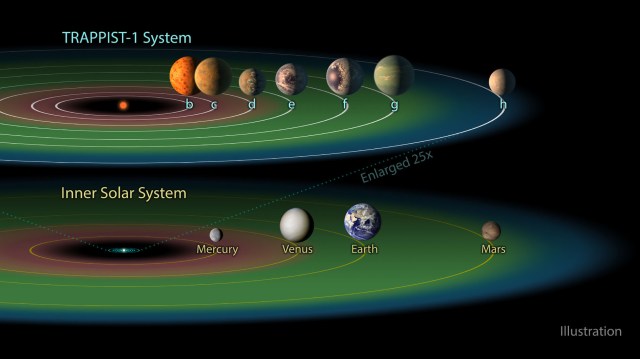
trappist 1

Image: NASA/JPL

There is a cognitive dissonance in not accepting evolution and climate science while at the same time getting excited about the potential for life on distant worlds. Both evolution and climate science are key areas of research for an astrobiologist in the quest to understand the dynamic nature of planets and their ability to support life. People find it easy to think about these phenomena when they take place elsewhere in the universe, but when we turn around and look at our own planet, we can’t apply the science to our own situation. There is an opportunity for educators to take advantage of this relationship, engaging the imagination of students while they learn about the factors that make life possible on other worlds. It may prove easier to think about the history of these distant objects than it is about our home planet. Can we apply the lessons learned on distant worlds to foster a better understanding of our own situation?

For a learner asked to learn and apply new skills and ideas, it frequently comes down to going beyond what they are familiar with, looking at a completely different situation, examining it in fine detail, then building a generalizable model to their own situation. Sometimes one is just too close to the object under scrutiny to look at it with the objectivity needed for understanding and acceptance.

This post originally appeared as the Education Matters column in the spring 2017 issue of Mercury Magazine, a publication of the Astronomical Society of the Pacific.

Posted in Uncategorized | 1 Comment

Creating a Revolution, One Eclipse at a Time

Alex Longo is not a typical 16-year old. As an eighth grader, he submitted a proposal to the Mars Rover 2020 landing site selection committee. Now a high school junior, Alex’s proposal, and his in-person advocacy have resulted in the inclusion of his proposed landing site as one of the eight finalists for selection. Alex is a regular participant in NASA meetings regarding Mars exploration, giving talks and publishing papers. He was a panelist at a recent public talk given at the 2016 AGU conference in San Francisco, sharing the dais with the lead scientist for Mars exploration. Alex credits his parents taking him to see his first space shuttle launch at the age of 5 as the spark that put him on the path he is now on.

While the story of Alex is unusual due to the publicity surrounding his contribution, it is common in its demonstration of the importance of experience to spark the interest and ultimately the drive to learn and contribute in a meaningful way. While everyone in some way has had their curiosity sparked, the vast majority of people remain anonymous.

In an era when science and facts are marginalized, the experience of observing natural phenomena bears increasing importance and relevance to fostering scientific literacy. A phenomenon touches someone emotionally, activating the affective realm, creating a sense of wonder and awe, which may lead to curiosity, and then on to appreciation and understanding. The ASP’s Sky Rangers program was designed to take advantage of this progression, working with park rangers to help foster their interpretive skills about the night sky for park visitors. Interpretation is different from instruction in that it helps people process their personal experience and find relevance to their lives. Many times it does result in individuals seeking out information as their cognitive realm is activated in the quest to learn more.

The ASP’s Project ASTRO has sought for well over twenty years to spark the imagination and curiosity in young learners through providing a personal connection to someone who takes great joy in experiencing astronomical phenomena. The relationship building between volunteer astronomer and teacher, and the students they work with is in many ways far more important than the exposing of facts and data related to astronomy. The most effective partnerships are always where the astronomer actively engages learners in some aspect of astronomical phenomena, working with them and mentoring their growth in appreciation and understanding through interpretation rather than exposition.

All of us in the educational community make a great deal about inspiring the next generation of scientists, educators, and fostering a scientifically literate population. We actively work to create change, not only for future generations, but for the current one as well. Some pundits have suggested we have entered into a “post-fact” era lacking objective truth with an apparent disdain for facts and science. This “post-truth” society is still willing to embrace experience and the depth of emotion it can engender, something we can perhaps take advantage of this coming year. A total, or even a deep partial solar eclipse has the potential to create a powerful emotional experience. As one of our colleagues says related to the upcoming total solar eclipse on August 21, 2017, an eclipse is the most democratic experience nature has to offer. Our ability to offer this experience to all through providing safe viewing opportunities, and interpretation not tied to dry facts and statistics may result in the change we find difficult to create on our own through more formal channels such as curriculum, essays, and press releases.

If we are serious about creating a revolution in the way people consume and apply science, then perhaps those of us who have experienced a total solar eclipse on other occasions should consider including in our personal agenda for August 21, 2017 the mission of helping those who would benefit from our guidance and interpretation. As noted, personal connections are a catalyst for sparking the curiosity and interest of learners of all ages. Who knows how many Alex Longos remain uninspired and unknown out there. Perhaps even the next child you give a pair of eclipse glasses, or yield the eyepiece to so they can see the same phenomenon you found inspirational the first time you saw it for yourself many years ago.

This post originally appeared as the Education Matters column in the winter 2017 issue of the Astronomical Society of the Pacific’s Mercury magazine.

1-eclipse2017_usa-500x386

Illustration courtesy of Michael Zeiler: Great American Eclipse.com

Posted in Astronomy, Education Matters, Science Education, Uncategorized | Leave a comment

This Land is Our Land, and Our Legacy

This week, President Obama declared the Bears Ears area in Utah, and the Gold Butte area in Nevada as National Monuments.  Designations not without controversy in some circles.  The primary issue those opposed to the designations have is related to their removal from places where resource harvesting is allowed.  They characterize the action as a “federal land grab,” which makes no sense since the areas already belong to the federal government.

When the Taliban tears down ancient Buddhist temples, or ISIS destroys archaeological sites we condemn them for not honoring the past. And yet, in our own country some people claim and fight for their ability to deface and dishonor the lands sacred to those who were here first. Designating these places as monuments will allow all people continued access to the land, and not lock them up for the privileged few to pillage in an effort to enrich their coffers.

Setting aside Bears Ears and Gold Butte really means these areas will remain in the public domain, giving me, and you, the ability to one day visit, and revel in the history written both in and on the rocks.

In the meantime, I continue to visit a cathedral carved from stone, with waters rushing over cliffs and through canyons, and a thin veneer of trees and brush softening the landscape.  A place belonging to all of us, and not just the privileged few as their private playground.  Our ability to care for the land “for the benefit and enjoyment of the people” speaks to our ability to care for one another, preserving those places important for cultural awareness, as well as places where we find refuge in natural beauty and solitude.  It is in these places where we find the very best in ourselves, and in humanity.

Images: Yosemite National Park, California / December 24-27, 2016

dsc_6764

Yosemite Valley from Tunnel View overlook

dsc_7207

The lower face of Half Dome

dsc_7328

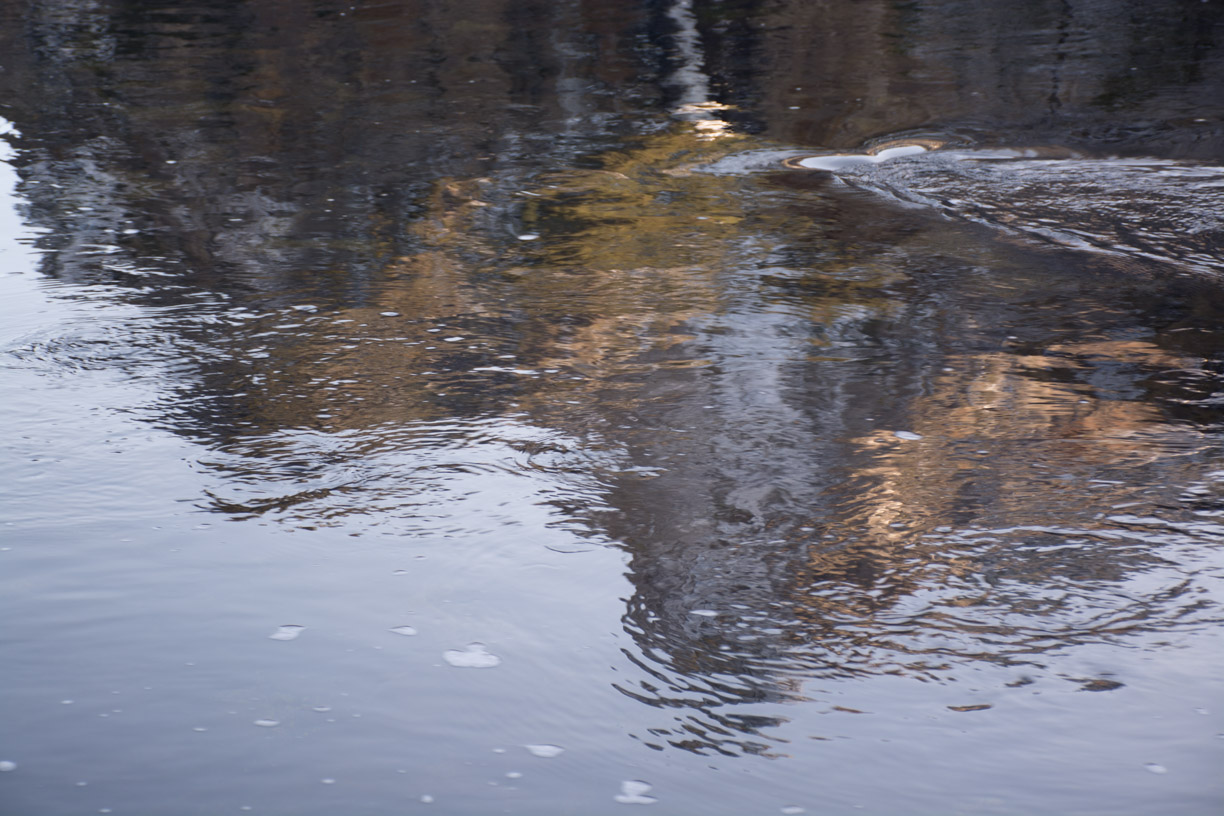
Reflections in the Merced River

dsc_6841

Reflections in the Merced River

dsc_6932

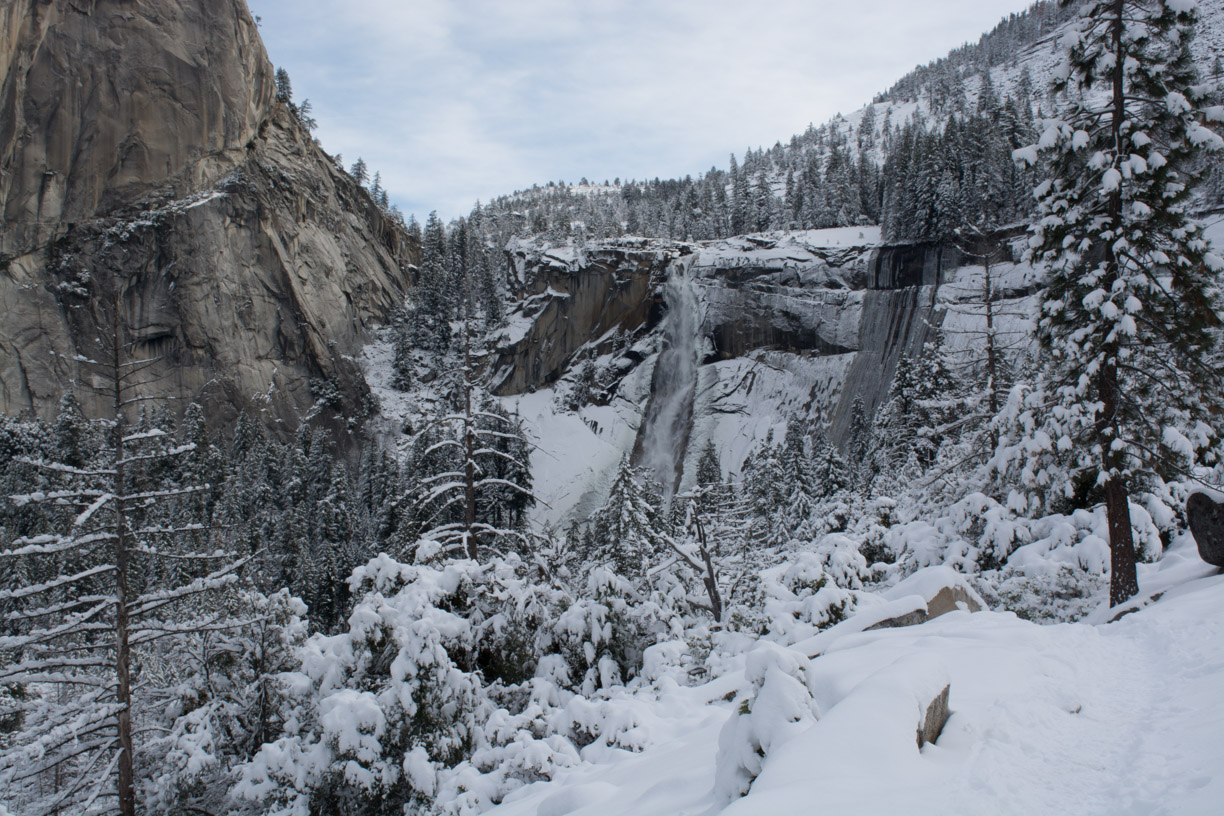
Nevada Falls from Clark Point

dsc_6816

After the snowstorm

dsc_6811

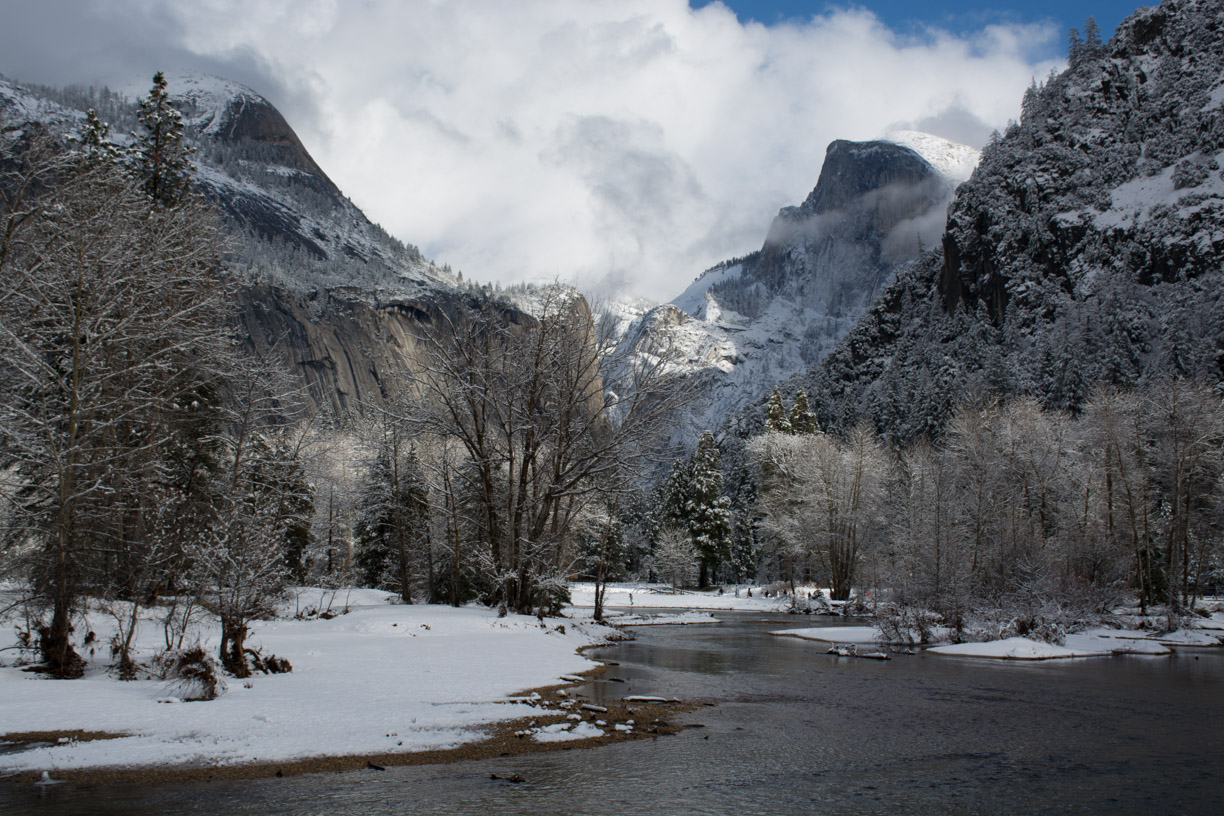
Half Dome and the Merced River

dsc_6854

Yosemite Falls from Clark’s Bridge

Posted in Environmental Issues, Yosemite | 1 Comment

Reflecting on Deep Time in a Young Landscape

Walk away quietly in any direction and taste the freedom of the mountaineer. Camp out among the grasses and gentians of glacial meadows, in craggy garden nooks full of nature’s darlings. Climb the mountains and get their good tidings, Nature’s peace will flow into you as sunshine flows into trees. The winds will blow their own freshness into you and the storms their energy, while cares will drop off like autumn leaves. As age comes on, one source of enjoyment after another is closed, but nature’s sources never fail.

  • John Muir, Our National Parks

Going to the mountains is a pilgrimage.  For as long as I can remember, the mountains have provided a haven, a place for contemplation, a respite from the the ordinary.  In younger days it was the Cascade Range, with its volcanic edifices atop a basement of older plutons and metamorphic rocks.  Then later the volcanic landscapes of the Oregon Cascades, the stacked metasedimentary rocks of the Canadian Rockies, the Overthrust Belt of western Wyoming. and the remote reaches of Alaska’s Brooks Range.  It is relatively recently I discovered the varied mountains of California, including the starkly beautiful ridges and valleys in the Transverse Range and Santa Monica Mountains.

The granite landscape of the Sierra Nevada draws me in.  At first glance, the rocks are uniform.  Taking the time to really look one starts to see subtle differences in texture, color, and how they respond to weathering.  A background in geology definitely helps in seeing diversity in a seemingly endless gray-white landscape.  Climbers have a better sense of the geology than the casual observer as their life may depend on their ability to “read the rocks.”

Yosemite always beckons.  For the first time in over a year, I heeded the call.

dsc_5381

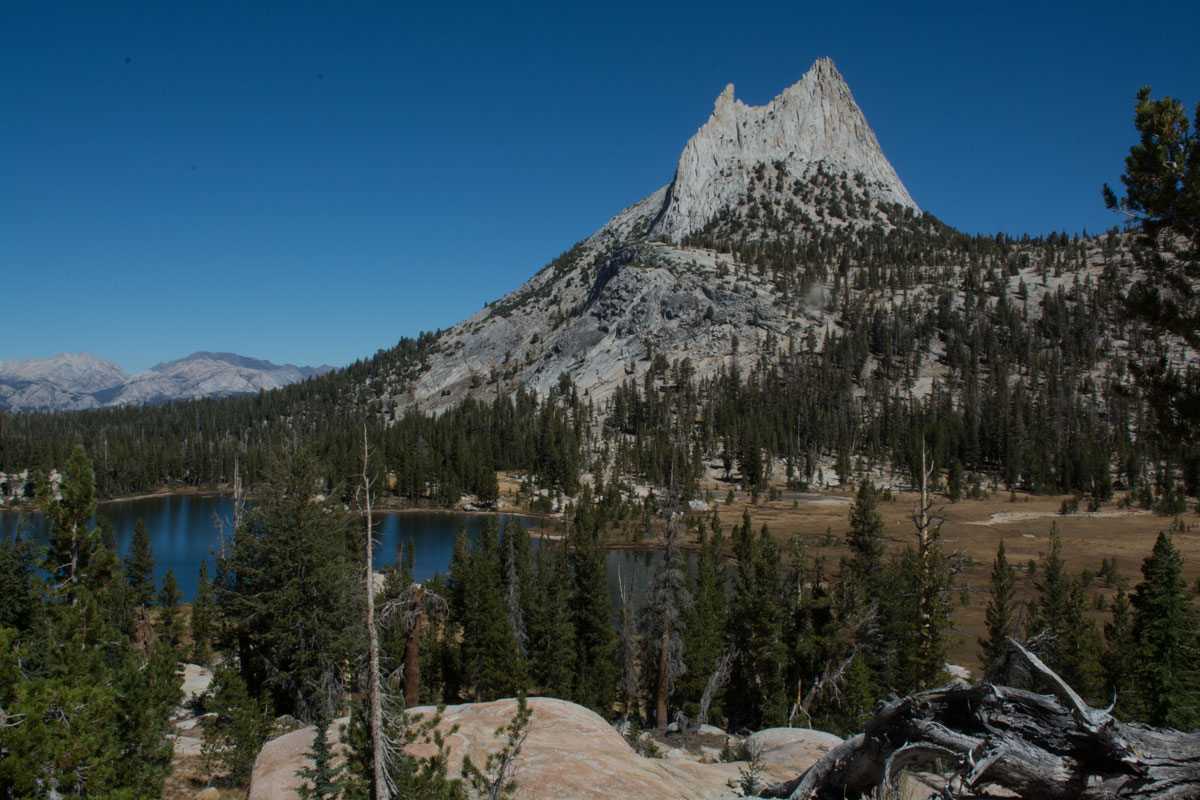
Cathedral Peak and Upper Cathedral Lake from Cathedral Pass

Even in fall the Cathedral Lakes trail has upwards of a hundred people following Muir’s admonishment.  The trail to the lakes, and above to Cathedral Pass cross the Cathedral Peak Granite, a marvelous rock with very large megacrysts of the mineral orthoclase, a potassium-rich feldspar.  These crystals are pervasive in the rock, with many areas where you find large masses of these 2- to 4-inch crystals.  The orthoclase is more resistant to weathering than the surrounding smaller crystals, forming knobby surfaces.  Glacially polished surfaces show no preference for orthoclase or groundmass, they both polish up equally well.

dsc_5289

Weathered Cathedral Peak Granite with knobby orthoclase megacrysts

dsc_5298

Glacial polished Cathedral Peak Granite

When hiking the trails of Yosemite, one is never alone.  Which made a hike to Mono Pass, then onward to Parker Pass all the more notable.  It was a solitary hike, with only the rocks, stunted trees in the high country, raucous Clark’s Nutcrackers, and the wind for company.  It was not until the last hour of the hike, on the way back to the trailhead, when I encountered another hiker, then saw five other people within the space of a half mile.

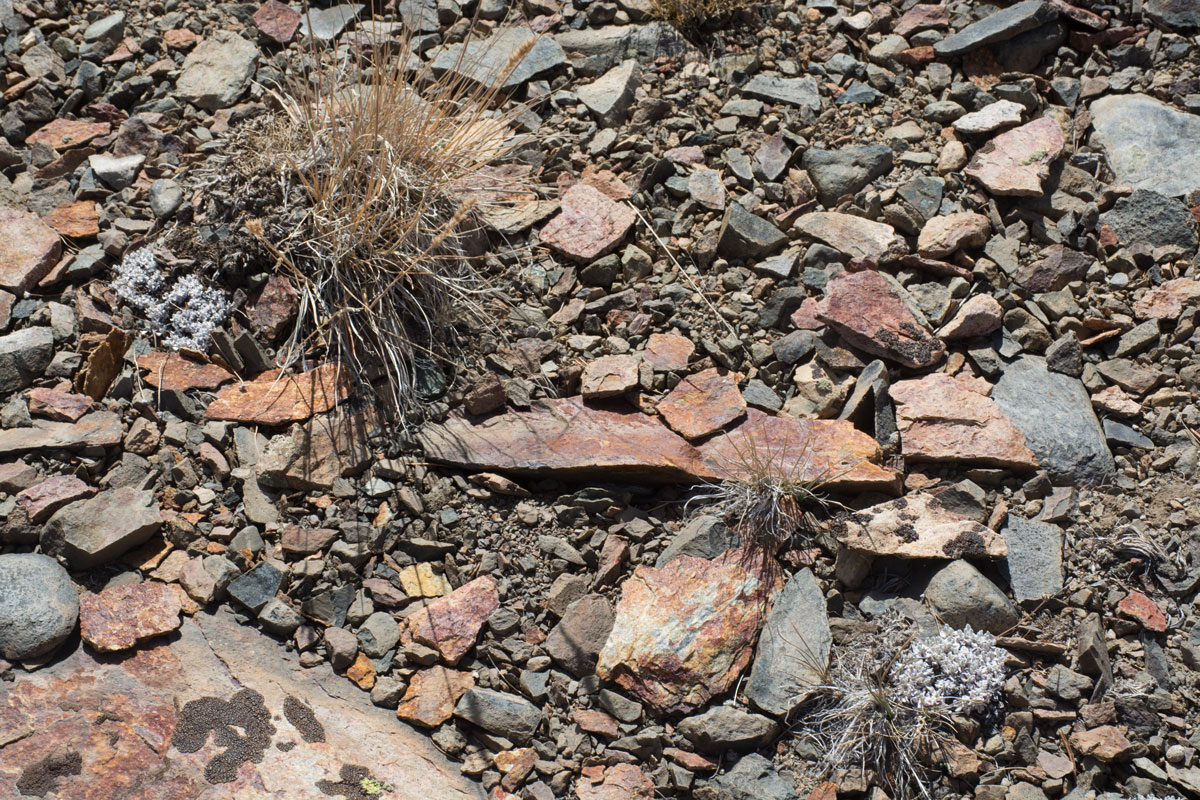
The hike to Mono and Parker Passes takes one into the country rock which surrounded the granite masses when they were intruded.  Dark, gray and red, these rocks are metamorphosed sedimentary and volcanic rocks far older than the granites.  At times it was easy to see the contact zone between the two types of rocks, which provides a sense of some of the dynamics that took place when the granites were intruded.  The metamorphic rocks are more easily weathered, and tend to break down into smaller fragments, which results in less craggy peaks compared to those of granite.

dsc_5614

Mono Pass with Mono Lake in the distance

dsc_5596

The flat expanse of Parker Pass, elevation 11,100 feet ASL

dsc_5551

Spillway Lake at the base of the Kuna Crest; note the contrast between the dark metamorphic rocks just above the lake, and the lighter Kuna Crest Granodiorite of the ridgetop

dsc_5636

Metamorphic rock pavement on the divide between Mono and Parker Passes

These excursions into the back country reveal the depths of time.  The story of mountain building in this part of the world starts with ancient rocks which had their origins undersea and were subsequently altered through the action of heat and pressure, the emplacement of granite at a time when dinosaurs roamed a good part of the Earth, and culminates with the recent uplift associated with the formation of the basin and range province covering much of Nevada.

It is the much more recent tearing away at these mountains that created the allure drawing millions to Yosemite each year.  The evidence is everywhere: from the can’t miss vertical cliffs and bare granite domes, the hanging valleys with cascading waters, to the subtle ridges of moraines left behind when glaciers retreated, and the polished rock surfaces.  Weathering and erosion have left their mark on the land.

The tidings of the mountains are the very story of the Earth itself, nature’s source for the tale of deep time.  It is there for all to read and hear, one just has to slow down to look and listen.

Panorama looking northwest from Parker Pass

Panorama looking northwest from Parker Pass

Posted in Earth History, Uncategorized, Yosemite | 1 Comment